
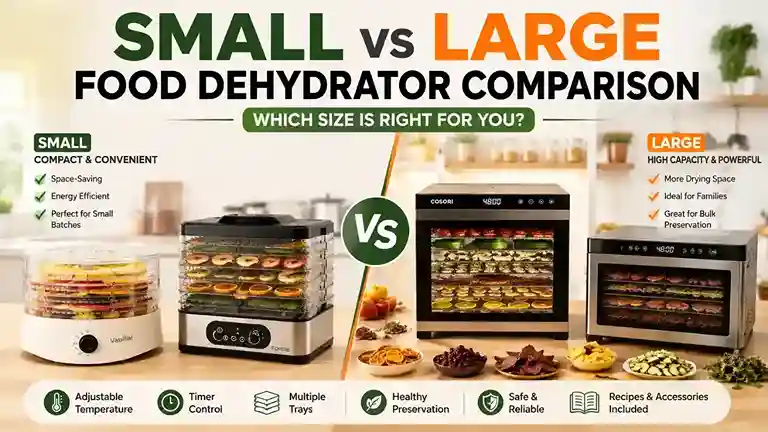
It can be deceptively hard to choose between a little and a big food dehydrator. A smaller model saves counter space and energy, but a larger dehydrator can handle more food at once. It Depends! How often you dehydrate, what food items/amounts you are preparing, how much air drying space you need and finally; how much room do you have in your house?
This small vs large food dehydrator comparison breaks down the pros and cons of 6 examples of various popular brands – including five compact trays models, up to large-capacity stainless steel machines. We also discuss the pros, cons and best use case of these to help you choose wisely.
ALSO READ:Keurig K-Cafe vs Ninja DualBrew Pro Coffee Maker
Food Dehydrator Size Comparison – Small vs Large
| Product | Size Type | Trays | Temperature | Best For |
| ——————————- | ———— | —-: | ———– | ————————- |
| Small Food Dehydrator Dryer | Small | 5 | 104-158 °F | Compact kitchens
| Small Jerky Dehydrator | Small | 5 | 95–158°F | Beginners & small batches |
Model Name Dimensions Size Watts | Temp Range Purpose Model name FOHERE Food Dehydrator Small/Medium 5 95-158 °F Everyday Home
| Cosori Food Dehydrator | Medium| 5 |95–176°F|Jerky & snacks
Cosori 10-Tray Dehydrator Large 10 95–165°F Families & large batches |
| 8-Tray Food Dehydrator Machine | Large | 8 | Up to 167°F | Larger batch
Difference between Small and Large Food Dehydrators
The biggest difference is capacity. Devices with three to five trays for small batches of fruits, vegetables, herbs, jerky or treats cords from dehydrators. They are more manageable to store and are typically the most intuitive for infrequent use.
More trays = More drying space for large dehydrators. Use them when you preserve garden produce often, make large batches of jerky or want to dehydrate multiple foods simultaneously.
A small mode does not mean that it will be less capable of. The fundamental trade off epic is how much sustenance you can cycle at the same time.
1. Mini Food Dehydrator Dryer – Healthier Snacks choice
One more compact food dehydrator, this five-tray model is perfect for the user who still wants complete control of temperature but doesn’t need a giant capacity. The trays are about the same size as 10.23 × 10.23 inches, and a spacing of 0.79 inch provides space for common foods fruit, vegetables, mushrooms, herbs, and meat.
Drying should be done at various temperatures, and it has an adjustable temperature range of 104F to 158F. There are useful safety features such as its inability to overheat and it comes in a BPA-free food grade plastic structure.
Pros
- Compact countertop design
- Five removable trays
- Adjustable temperature
- Adequate air circulation to ensure even drying
- BPA-free food-grade material
- Overheating protection
Cons
- Smaller drying capacity
- Narrower temperature range than some rivals
- More appropriate for small batches

Best For
Product Highlights: Great for Small Kitchen, Occasional Dehydrating, Herbs / Fruit / Mushrooms and Making Your Own Snack. **
2. Mini Food Dehydrator For Jerky, Fruits, Herbs and Pet Treats
For those of you who have been looking for a practical option with counter space being the most important thing, this model is yet another solid bet. It has a 250W heating system and comes with 5 transparent, adjustable in height trays.
The temperature is adjustable between 95°F and 158°F, and a powerful 72-hour operation capability comes in handy for foods that need to be dehydrated for longer periods of time. It also comes with see-through trays so, as the food cooks, you can check on it without having to keep opening up the machine.
Pros
- Space-saving design
- Low 250W power system
- Five adjustable trays
- Up to 72-hour operation
- Transparent trays
- Dishwasher-safe trays
- Includes cookbook and manual
Cons
- Capacity for larger households is limited
- – Less powerful than larger models
- The manual control knobs may feel rudimentary.

Best For
Ideal for Beginners; Apartments, Dorms, RVs; Pet. Treaties; Fruits; Herbs and Dehydrating Small Batch JerkyBest **
3. FOHERE– 5 Trays BPA-Free Food Dehydrator
FOHERE* — The most bang for your buck; its familiar easy-to-read controls, with a *400W heating system** helped it step up in convenience. It has five stackable trays (11.42 inches each) you can adjust for food thicknesses.
Temperature from 95°F to 158°F and timer up to 48 hours. The trays and the lid are dishwasher-safe for easy cleanup.
Pros
- 400W performance
- Digital temperature and timer controls
- Five large stackable trays
- Quiet operation
- Dishwasher-safe components
- Compact storage design
Cons
- *Ten-thousand feet may be far enough but possibly not the app 23.
- Maximum temperature: 158 ° F
- Not great for extremely large preservation jobs

Best For
Best for daily food dehydrating when you want digital controls without going to a full-size dehydrator. **
4. Cosori Food Dehydrator – 5 Tray Stain Steel
The Cosori food dehydrator has 5 stainless steel trays and around 3.1 sq ft drying space. With a range of 95°F to 176°F, it can be set more liberally than many mini models.
Operation is simple with four presets—jerky, fruit, vegetables and yogurt. The rear fan evenly circulates the hot air across the trays, and is compact enough to fit on a counter.
Pros
- Stainless steel trays
- 3.1 ft² drying space
- Temperature up to 176°F
- Four useful presets
- Rear fan for even airflow
- Compact countertop footprint
Cons
- Not as rugged as 8- or 10-tray models
- Pricey for basic compact dehydrators
- Potential Disadvantages⇒ 5 trays could be restrictive for bulk meal prep

Best For
Best for people looking for a compact machine that uses stainless steel trays and has more precise temperature flexibility. **
5. Cosori Food Dehydrator – 10 Stainless Steel Shelves
If top capacity is the aim, this 10-tray Cosori model represents a big upgrade. It has about 16.2 ft² of drying space, and it is far better for families and anyone who routinely preserves foods.
Adjustable from 95°F to 165°F in one-degree increments with a 48-hour timer. The purpose of the rear fan being to disperse air throughout the drying chamber.
Pros
- 10 stainless steel trays
- 16.2 ft² drying space
- Excellent batch capacity
- 1°F temperature adjustments
- 48-hour timer
- Suitable for large families
Cons
- Expanded — Takes up a lot more space on disk
- = The biggest downside with the higher capacity can be taking up more space on your countertop.
- For infrequent users, it may not be even needed

Best For
*Ideal for Large families, Gardner’s, regular dehydrating batches or Commercial Prep & Processing Own jerky *
6. Food Dehydrator Machine – 8 Stainless Steels Trays
650W Dehydrator : A large capacity, feature-rich dehydrator It has eight stainless steel pans, a mesh pan plus drip tray, recipe book, interior light and a viewing function.
It can be adjusted to a maximum of 167°C and the timer can be set up for as long as 48 hours. It features a dual-layer insulation to help keep the outside cooler while in use.
Pros
- Powerful 650W motor
- Eight stainless steel trays
- Up to 167°F
- 48-hour timer
- Includes mesh and drip trays
- Interior viewing light
- Auto shut-off
- Quiet operation
Cons
- Chunkier than a more compact five-tray MediaUnits
- Need considerably more power than the smallers models
- May take more storage space

Best For
*Best for Families & Large Users Looking For Extra-Capacity Dehydrator With Prominent Airflow, Stainless Steel Trays And Accessories *
PROS & CONS OF SMALL VS Large food Dehydrator #1
- Small Dehydrator Pros
- Takes up less counter space
- Easier to store
- Usually suitable for apartments
- Good for beginners
- Convenient for small batches
- More cost-effective if used infrequently
- Small Dehydrator Cons
- Limited drying capacity
Smaller quantity of trays and accessories as a rule
- Large Dehydrator Pros
- Much greater capacity
- Processes more food at once
- Ideal for families
- Excellent for bulk preservation
- Ideal for frequent jerky making activities
- Can dehydrate multiple foods at the same time
- Large Dehydrator Cons
- Requires more storage space
Final Verdict
Neither size is better but the small vs large food dehydrator comparison shows that Small little biscuit dehydrators are certainly super useful for there small enough that you do not ever have to move them around or anywhere they will still always fit however a bigger dehydrator may be more efficient. Big dehydrators offer much greater capacity and are ideal for families, gardeners and regular food preservation.
For small counter-tops, either the Small Food Dehydrator Dryer or FOHERE five-tray model is appealing. The Cosori five-tray model is a great choice if you need a small machine with stainless steel trays. However, if maximum capacity is your main concern, then the Cosori 10-tray or 8-tray 650W machine is a far better option.
*The most ideal dehydrator for you is the one that corresponds with your available space, batch size, food types and how often you use it— not merely the machine with a lot of trays. *
FAQs
Would you like a small food dehydrator?
Yes. For limited space or typically smaller batch size, a little dehydrator can be perfect. Especially good with fruits, herbs, veggies, mushrooms, jerky -> pet treats
Q: Are bigger dehydrators better than smaller-based dehydrators?
Not necessarily. Essentially, you need to decide on a small model or a large dehydrator, as at times the dehydrating will be quick and as such a large dehydrator is suitable when there are high volume drying plans.
Dehydration is the process of removing moisture and inhibiting bacteria, yeast, and mold spores from growing (and using up beautiful food!) by eliminating their humidity-based environment.
Of the models in this comparison, the Cosori five-tray dehydrator is an excellent option for people who need stainless steel trays and multiple presets in a small size. The FOHERE is another decent choice; digital controls are necessary for you.
What size dehydrator is suitable for a family?
If your family spends a lot of time dehydrating food, an eight- or 10-tray model is the most logical choice. Of these six, the 10-tray Cosori offers the most declared drying space at 16.2 ft² (almost 9 square feet larger than its closest rival).
Q — Can you make beef jerky in a small dehydrator?
Yes. However, some dehydrators can still be very small-useful jerky as long as you are able to bring the machine up to a safe temperature and practice safe food-handling standards along with USDA guidelines.
Does big dehydrator use more electricity?
Bigger models also tend to come with higher-powered heating systems so they can draw more electricity. Their bigger capacity allows you to process larger quantities of food in one batch, which could potentially make them more suitable for every day use.
How many trays do I need in a food dehydrator?
Usually five trays is fine for beginners or small households. First of all, eight to ten trays are preferred if you dehydrate larger quantities on a regular basis.
ALSO READ: Best 6 Stainless Steel vs Plastic Dehydrator: Which Is Better?